26th May 1982 was a special day in the history of Aston Villa Football Club. I wasn’t born yet, but the footage of my club’s European Cup final victory in Rotterdam is burned onto my retinas; it’s almost as if I know it won’t happen again. Villa were the underdogs that night and faced the mighty Bayern Munich. Before kick off, the camera runs along the teams as they line up on the field, and Bayern look like a machine. They’re big, intimidating and look extremely serious. And there, all beard and afro, stands Paul Breitner.
Despite not lifting the European Cup in 1982, Breitner was a well-decorated player and a man whose influence and aura extended far beyond the football pitch and the boundaries of his own nation. His politics singled him out in German football and he refused to conform to any West German stereotype as he grew a tremendous afro-style hairstyle and an uncompromising beard, swept up trophy after trophy as a swaggering left back with unusual attacking intent and a vicious shot.
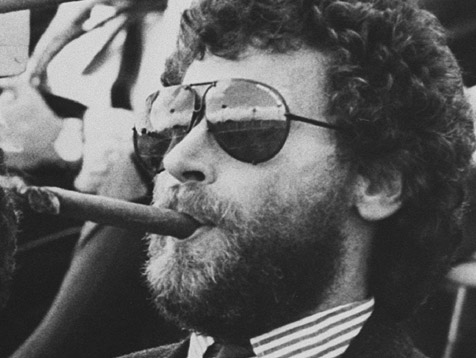
Breitner was one of a kind, proudly flaunting his left-wing views and thriving on the jeers and judgements of German fans and even his team-mate Franz Beckenbauer. Communist sympathies have rarely been widely welcomed anywhere, but Breitner never really seemed to care that he was flying the red flag alone. No, this was a man with total confidence in his views, his appearance and his football. The remarkable photograph below, which was found by (and on) Footballers With Beards, is no apparition. That really is Paul Breitner posing with Chinese propaganda in front of a portrait of Chairman Mao. My kind of icon (Breitner, that is, not Mao).
Today, Breitner is a commentator in a now-united Germany and an advisor to Bayern, a role he accepted in 2007. The left-wing leanings, by the way, include a fair bit of willful posturing. Breitner caused further controversy when, in 1982, he shaved his mighty beard off in exchange for a hefty payment from a cosmetics company. He drove an expensive sports car and once spoke of peddling his ass to make money, although he didn’t quite put it in those words (or mean it literally).
Vitals: Paul Breitner
Clubs: Bayern Munich, Real Madrid, Eintracht Braunschweig
Career League Goals: 103
International Caps: 48
Born in the same Bavarian town as Bastian Schweinsteiger, Breitner joined Bayern Munich as a teenager in 1970 and quickly started hoarding medals. In 1972, 1973 and 1974 he picked up three consecutive Bundesliga titles, the first being complemented that summer by a winner’s medal in the 1972 European Championships. West Germany were led by goals from Gerd Müller as they defeated hosts Belgium and the Soviet Union to lift the trophy at Heysel. Starting out as a nominal left back, Breitner in fact popped up all over the pitch to such an extent that one wonders whether his positional discipline was a revolutionary phenomenon or utterly non-existent. It doesn’t really matter.
1974 was an incredible year for an incredible player. In May, newly re-crowned German champions Bayern took Breitner back to Heysel, where a goalless 90 minutes and a 1-1 result against Atletico Madrid after extra time led to a replay in which the Germans demolished Atleti to win their first European Cup. Müller was again the hero, emerging as the competition’s top goalscorer thanks to a brace in the replay.
The 1974 World Cup is best known as the year the Netherlands failed to capitalise on their best chance to win the competition, but it was Breitner and West Germany who became champions on home soil. Breitner got the tournament underway with a bang, scoring the winner in the opening game against Chile (video below), a goal that he believes was more important than his other two goals in the tournament.
The second came against Yugoslavia in the second round, and the third was one of the most crucial goals in German football history. With the fancied Dutch 1-0 up in the final, Breitner stepped up to take a penalty after 25 minutes and beat goalkeeper Jan Jongbloed to equalise. The man himself explains why it wasn’t, in his opinion, a matter of ‘nerve’:
“I felt in good form so I went over, fetched the ball and placed it on the spot. I didn’t notice anything going on around me. From very early on, I learnt to concentrate absolutely in critical moments, using autogenic training. I’d also made an important observation - someone who approaches a situation like that intending to become a hero, is destined to become the biggest loser.”
Müller scored West Germany’s second before half time and the rest is history.
The next year, Bayern would retain the European Cup without Breitner. After securing World Cup glory, Breitner moved to Spain to join compatriot Guenter Netzer in a Real Madrid side that was desperate to return to winning ways. And while Bayern were continental champions in 1975 (successful in controversial circumstances on a sickening night all round in Paris) and 1976, Breitner helped Los Merengues get their wish. In 1974/75 Real won the title by an enormous distance from Real Zaragoza, and they repeated their success the following year by beating out Barcelona.
Breitner returned to Germany in 1977 and enjoyed a wonderful second crack at domestic football. After a season with Eintracht Braunschweig (incidentally just promoted back into 2.Bundesliga), Breitner found his way back to Bayern, with whom Braunschweig had finished level on points during his only season there. Now operating as a midfielder, Breitner led Der FCB to successive Bundesliga wins in 1979/80 and 1980/81. In ’81, he was named German Footballer of the Year, and came second behind his on-field partner-in-crime Karl-Heinz Rummenigge and ahead of Barcelona’s Bernd Schuster as a German trio dominated the Ballon d’Or standings.
Alas, 1982 would be a year a near misses for the man they called Der Afro. In the World Cup, he became the third player to score in two different World Cup finals as West Germany played second fiddle to Paolo Rossi and Marco Tardelli’s famous World Cup final moments. That disappointed came 46 days after Peter Withe’s shinned finish to give Villa a 1-0 win at Feyenoord Stadium.
1982 proved that Breitner was human, and he would retire the following year. For a relatively short career 12 major titles in domestic, continental and international football is a phenomenal return. But Paul Breitner was a footballer who was about so much more than the game itself, and he remains outspoken and influential. We won’t mention der 17 Stunden.
Tags: Bayern Munich, Germany, Paul Breitner