







How to crack the 'Big Four'
Monday, 13 April 2009
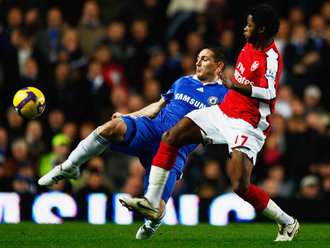
The increasingly predictable dominance of the so-called 'Big Four' is having an adverse effect on both the Premier League and on wider European football.
Domestically, the four teams in control of UEFA Champions League qualification - Manchester United, Liverpool, Chelsea and Arsenal - have become a closed shop, despite Everton's admirable dethroning of Liverpool in 2005.
Although European success typically rotates on a country cycle (i.e. Spain dominates for a few years, the Italy), there is an argument now that the Premier League's ability to attract huge revenue is taking English football into a position of strength on the continent which could blow the cyclical pattern out of the water.
Last season, England's four Champions League representatives had to beat each other to see any of them knocked out. Three played in the semi finals, and two in the final. This year, all four made the quarter finals - though Villarreal and Porto will fancy their chances of rocking the boat.
Whatever the reason, many football supporters see the dominance of these four teams as a serious problem. Of course, it's all about money. Cash breeds success, and success breeds cash.
Chelsea bought their success, there's no two ways about that. Manchester United have brilliantly exploited their support and resources, while Arsenal appointed a genius as manager and spent wisely where he deemed necessary. Over time, Liverpool have finally built a team worthy of a title challenge, thereby securing their place in the top four.
Of course, it's no coincidence that we talk about a 'Big Four' and there are four Champions League spots. It's a situation which is unsustainable, unappealing and fundamentally damaging to English football, which should be based on competition, not monopoly.
So, from this point on let's take it as a given that something must be done. For the rest of this post, I'll be presenting a few of the suggested solutions I've heard, and then adding my own.
Financial restrictions
Financial restrictions, such as salary capping, spending limits and revenue/outlay ratios would all, on the face of it, stunt the growing gap between the top four and the rest of the Premier League. But that's all they would do. This is no way to close the gap, as it would simply consolidate the positions of the league's teams, leaving the best of the rest hamstrung in their battle to crack the leading group.
Of course it's entirely academic (as are all of these suggestions), because the power sits in the hands of the big boys. They'd never let it happen.
Six plus five
Then, we have Sepp Blatter's six plus five proposal. Supporters of this scheme, which I have gradually come to oppose, often argue that it will help close the gap underneath the top four as well as improve the pool of domestic players available for the national team.
For me, that's simply not true. In much the same way as financial restrictions, I believe that anything that pauses the state of play in its current situation merely retains an uneven playing field. In this case, the best young English players would all end up at the biggest club. Basics, really.
Champions League Playoffs
Another suggestion I've heard about is a playoff for the final Champions League spot. The top three go into their respective stages in the competition on the continent, while the fourth and fifth - or the fourth, fifth, sixth and seventh - play off for the final spot.
Granted, this might have an effect, but I just don't like it as a concept. As much as I hate the status quo, the idea of the "wrong" team playing in the Champions League seems rather silly. I think they tried this out in Holland or somewhere and it went down like a lead balloon, and I see no reason for it to be more successful here.
Introduce some competition
So, no satisfactory solution yet. But I have an idea, and it's one which would have Michel Platini foaming at the anti-English mouth. The problem is that he is the only man with the power to take this decision and he wouldn't dare.
The idea? Take a Champions League slot away from England. This would introduce a bit of spice into the top four, break up their cosy little cartel. Wouldn't it be nice to end the assumption that United, Chelsea, Arsenal and Liverpool are going to be the top four, instead watching them fight it out between themselves to not be the poor sods that drop out.
It may hinge upon a bit of a conspiracy theory (the top four looks after itself), but you have to admit it'd be fun to see them scrap it out. And when one does, and then another, it opens the field right up.
(Photo: Sporting Life)
Posted by Chris Nee


6 comments:
You have to wonder if the situation will ever come to a head, or if the status quo (i.e. massive amounts of money but lack of serious competition) will hold. If I know anything about the powers-that-be in any sport, it's that "change" is not high on their favorite things.
You thought might add a bit of intrigue for that third spot, but it doesn't really solve the overriding issue: in the long term, is a league that shuts out 80 percent of its clubs from realistically challenging for the title (or in this case, Champions League spots) defeating the purpose of conducting the competition in the first place?
Maybe I'm asking the wrong question. I don't think that any of the possibilities you mention would have far-reaching effects, though maybe all of them together would. Regardless, those in charge won't make changes until they are forced to do so.
I'm absolutely certain nothing will ever be done. Until these teams bugger off, ten or fifteen years from now, into their boring Super League, we'll have to put up with their domination - and pay more and more money for the right to do so.
Big clubs will always have a dominating presence over the rest of the teams, and have the money to back that.
Its great to see the likes of Aston Villa and Everton, challenging the so called 'Big Four', but its very hard to break into that niche without the financial support.
Also it can be argued that Europe has ill effects on teams, look at Leeds United, and where they are today. Pompey and Tottenham have struggled this season.
While it maybe lucrative, its not always benficial.
I think the foundations have been laid for other to challenge, and that will hopefully continue.
We need the return of exciting football, although this season is up there with the title still up for grabs.
You make an interesting point, Chris, about how the top four have come to be so. In Chelski's case, it's down simply to the fact that they bought their way in. Liverpool too have had a reasonable cash injection, as have Man U to some extent (though these two also have a strong history and fan investment) - but the common factor amongst these three is they're all running a debt. I would say this, wouldn't I, but Arsenal isn't. Available cash/credit has allowed these clubs to cement their places at the expense of the "other 16".
The point is, other companies / businesses (i.e. outside of football) would barely be allowed to trade and would be under extreme scrutiny from creditors if they operated like these clubs do. This in my mind is what is unsustainable - to compete with the top four now means praying for a cash injection from a rich Russian/Arab/American which ultimately means bad debt.
So my proposal would be along the lines of what we're seeing in corporate finance after the credit crunch/banking collapse, i.e. scrutinise clubs' accounting more closely and put sensible pressure on clubs that overspend to curb their spending or else lose their standing. Already we see in the lower leagues that going into administration means losing league status (see Luton this week) so I don't see why "big" clubs should get away with it.
In a world that's increasingly governed by money, sensible financial fundamentals should be the bedrock, and not the shifting sands, of a club's right to participate.
I agree with you to a point, Big Mac, and I certainly think there is a double standard. Still, those clubs will almost always be able to carry their debt loads because credit will never be denied them; if that's the case, does anyone, much less the FA, have the right to question their practices?
That's more of a rhetorical question than my opinion; I'm really not sure how I feel about the matter.
In the U.S., we're completely unfamiliar with the financial issues that effect football clubs in England, so I'm not even sure how comfortable I am even posting this comment.
The problem is the UEFA Champions' League itself. It has created a plutocracy within European professional soccer. Sadly, I don't see that happening. I also don't see many Europeans getting that their entire system is inherently unsustainable since there are no rules. It's a real shame.
Post a Comment