





A to Z of Football: N is for...
Tuesday, 7 April 2009
...Non-League
Yeah, so I go on about it quite a lot but non-league football is important. Football is our national game, it's an essential part of our character and - believe it or not - it doesn't begin and end with the Premier League.
The real heart of English football lies in the fact that it's played from the top to the bottom of our society. Non-league has a real charm about it, it's home to the game's true characters, not the media whores of the Premier League.
At non-league football this season I've had a cheeky stroke of the FA Cup, had a beer with Brian Barwick, touched the match ball, stood next to a man wearing no shoes and enjoyed Tooting manager Billy Smith's touchline antics. That is what football's about.
...Nazi Germany
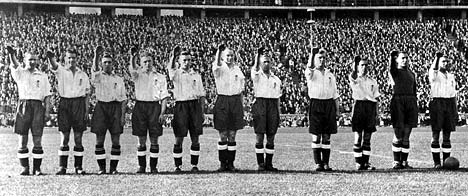
I don't often blow Aston Villa's trumpet on twofootedtackle, but I'm going to here. On May 14th 1938, England played Germany in Berlin and - as the picture above (from the Daily Mail) shows - gave a Nazi salute.
The following day, Aston Villa played a Germany XI. They refused to salute.
The legendary Eric Houghton played his part in instigating this refusal, and has since said that "they said we'd got to give the Nazi salute, you see, so we went to the centre of the field and gave them the two finger salute and they cheered like mad. They thought it was all right. They didn't know what the two fingers meant."
...Narcissism
nar⋅cis⋅sism. Noun. "Inordinate fascination with oneself; excessive self-love; vanity."
Sadly, narcissism is the defining characteristic of the modern day top flight footballer - and many below. I don't like to be too negative about the game, but the likes of Cristiano Ronaldo, Didier Drogba, John Terry and David Bentley make me sick as a dog.
And Gabriel Agbonlahor drives a white Lamborghini. Doesn't that just say it all?
...NASL
The North American Soccer League, Major League Soccer's predecessor in the USA and Canada kicked off in the late 1960s and lasted until 1984. The most famous legacy of the NASL was the New York Cosmos, a club which played home to the likes of Pele and Franz Beckenbauer and, according to Wikipedia, drew up to 40,000 supporters on a good day.
Other familiar names included the Tampa Bay Rowdies, San Jose Earthquakes and soon-to-be MLS expansion club Vancouver Whitecaps.
There's no need to tell the NASL story all over again, but it is seen by many European commentators as a blueprint for how MLS shouldn't operate. There were many factors behind the league's demise, but over here we tend to blame the signing of the world's greatest players in a nation that simply wasn't ready for them.
That's one of the reasons we saw David Beckham's move to Los Angeles as a little bit dubious.
Don't forget - the twofootedtackle A to Z of Football is a weekly feature, and your contributions would be welcome and appreciated. If you'd like a football term discussed, feel free to leave a comment and I'll look into it.
Posted by Chris Nee


8 comments:
I wonder about that Villa/Nazi salute story. There's a chapter in Simon Kuper's book Ajax, the Dutch, the War which notes that much of the shame felt about the England team's salute was retrospective. Kuper argues that the salute was pretty uncontroversial at the time -- indeed, England had saluted before a game against Italy in 1933. It was only after the war that it was seen as deeply embarrassing:
"For decades, whenever the match was recalled, on radio or television or in print, the testimony of the England players was sought. The problem is that they were unreliable witnesses. Members of a patriotic generation, who after 1945 knew the horrors of Nazi Germany as they could not have done in 1938, they were aghast at what they had done. Their version of salute and match were invented after the fact."
A bit of googling led me to this, which quotes from David Downing's book The Best of Enemies: England v Germany (which I haven't read), on Villa's tour of Germany, the first game of which was supposedly the scene for the non-salute:
"This excellent result was marred by controversy. After the match most of the Villa team hurried off the pitch, but attempts were made to get them back on in order to join the Germans in the Nazi salute as the FA had 'requested'. Motivated less by politics than by the bad feeling engendered during the match, 'some' of the players refused to return and adhere to instructions. The German crowd whistled and booed, their anger at Villa's offside tactics and an appalling foul by Massie now compounded by the implied disrespect to their beloved Fuhrer.
"The Foreign Office was furious with the FA, and the FA was furious with the Villa players. Arms were twisted, and after the second and third matches of the tour, in Dusseldorf and Stuttgart, the Villa players obediently performed the dreaded salute".
I wonder if Houghton's two-fingered-salute story was born out of a similar impulse to the emergence of the story about the shameful reaction to the salute by the national team and the latter's purportedly indignant response to being instructed to perform it. From some cursory web-searching, the only source for Houghton's story appears to be Houghton himself. My research on this hasn't been very extensive, so I stand to be shot down, but: could it be a myth?
Interesting thoughts.
It just so happens that I know just the man to ask - I'll come back to you.
Excellent -- I look forward to it.
Fredorrarci, it seems there's something in your comments.
I put in a quick note to the club historian, John Lerwill, and while he argues that nobody can really know unless they were there, the story if far more complicated than the one which resides in general assumption.
He believes there is an element of mythology in this, but does not know to what extent.
Nice work, Chris. Cheers.
Wow, the early days of dark times in 1938. Did public sentiment go along the lines of - Germany is rebuilding itself after its decimation via WW1 - kind of "we applaud your efforts at making a comeback" not grasping the dark character of it all?
We hardly ever grasp the character of the future in advance.
On a lighter note, I understand the mention of Cristiano in the same paragraph as narcissism, but I can't believe you're impuning white Lamborghinis. Personally the only colors I would drive are red, black or yellow. I'd actually like yellow best as it screams out "Look at me, I'm driving a Lamborghini -- and you're not!"
Admittedly color choice of Lamborghini hasn't troubled too much.
The 1938 salutes took place shortly after the Anschluss, at a time when the relationship between Nazi Germany and the other major European powers was tense. To quote Kuper again:
"Meanwhile British officials were trying to work out whether the team was going to give the Nazi salute. This was a common diplomatic problem in the 1930s, a decision every sports team playing Germany had to make [...]
"The English could have avoided saluting. But war between Germany and Britain seemed very possible just then. A few weeks earlier the Germans had annexed Austria [...] and now they were planning to take the Sudetenland. In the phrase of the day, 'It needed only a spark to set Europe alight.' If it took a salute to avoid that, well...
"FA secretary Stanley Rous favoured a salute for different reasons. Two years before, at the march-past at the Berlin Olympics, Rous had seen the German crowd jeer the British team for only giving Hitler the 'eyes right.' He thought a salute would put the crowd in good temper."
I would imagine the same thinking informed the decision over whether Villa should salute, too.
Note that a few short months later, Germany had taken the Sudetenland and Czechoslovakia, and the infamous Munich Agreement was signed. So as you can see, it was a strange, complex time.
(Apologies for hijacking your comments section, Chris!)
Post a Comment